Understanding Sustainability Scores
Every product in ReRoute AI receives a sustainability score from 0 to 100. This score helps you quickly assess the environmental impact of the items you purchase and find greener alternatives.
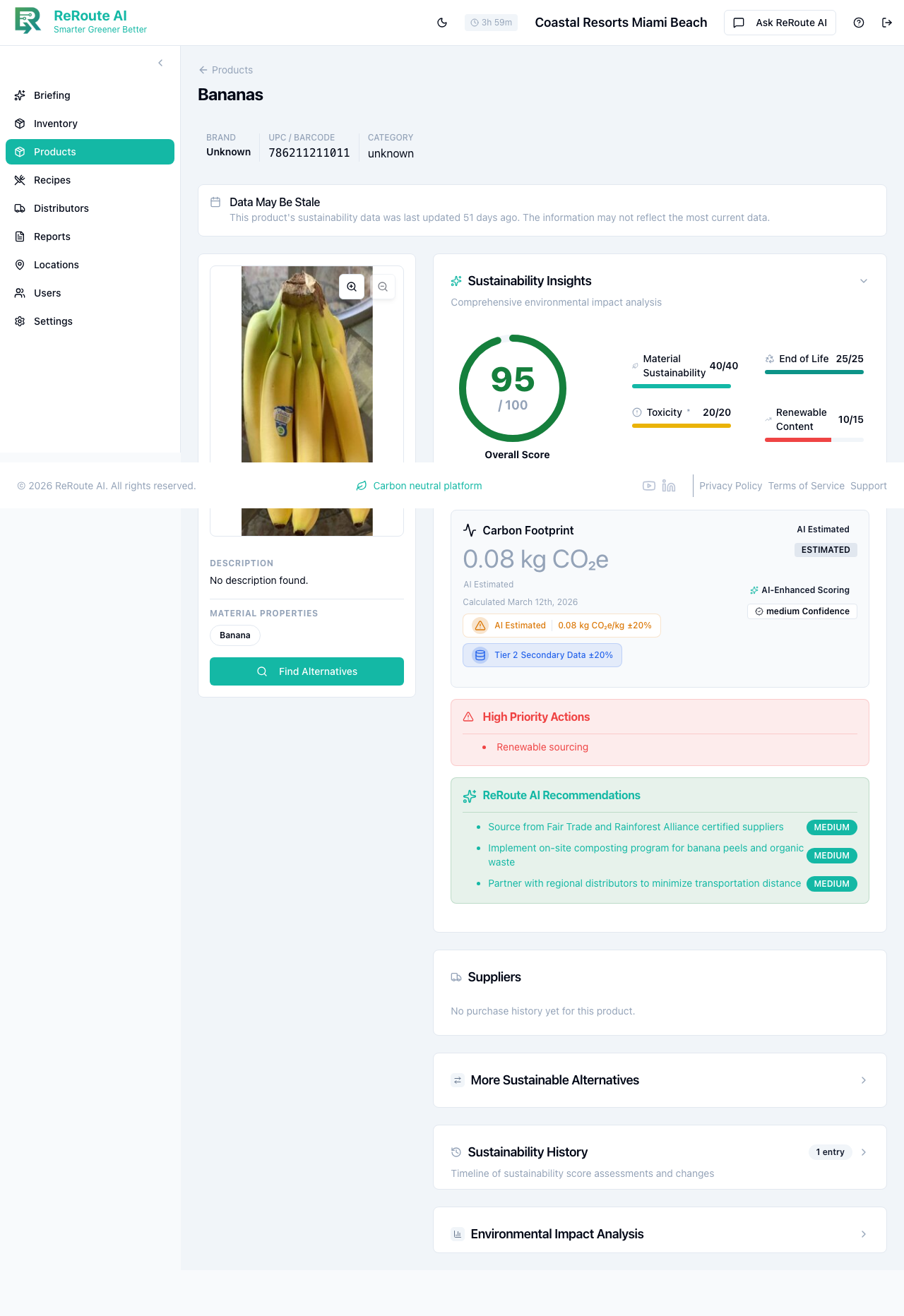
What the Score Means
Your sustainability score reflects how environmentally friendly a product's packaging and materials are. The score combines four factors:
- Material efficiency (up to 40 points) -- How sustainably the product is made and packaged. Renewable materials like bamboo or bagasse score higher than conventional plastics.
- End-of-life options (up to 25 points) -- What happens after you use the product. Compostable and recyclable items earn more points than landfill-bound ones.
- Toxicity and safety (up to 20 points) -- Whether the materials contain harmful chemicals. Non-toxic, food-safe materials score best.
- Renewable resources (up to 15 points) -- Whether the product comes from renewable sources. Plant-based materials outperform petroleum-based ones.
These four factors add up to your total score out of 100.
Grade Scale
Your score translates to a letter grade so you can see at a glance how a product performs:
| Grade | Score Range | What It Means |
|---|---|---|
| Excellent | 80--100 | Best-in-class sustainability. Compostable, renewable, or highly recyclable materials. |
| Good | 60--79 | Above-average environmental performance. Recyclable or partly renewable materials. |
| Average | 40--59 | Room for improvement. Conventional materials with some recyclability. |
| Poor | 0--39 | High environmental impact. Consider switching to a greener alternative. |
How Scores Are Calculated
ReRoute AI uses a three-tier approach to make sure every product gets the most accurate score possible:
- Real emissions data -- When verified carbon footprint data is available from environmental databases, the platform uses that first. This gives you the most precise score.
- AI analysis -- If no verified data exists, ReRoute AI analyzes the product image and details using AI to assess the materials, packaging, and environmental impact. Most products are scored this way.
- Category averages -- As a fallback, the platform uses known averages for the product's material type (for example, bamboo products typically score 85--89, while conventional plastics score 40--50).
Once a product is scored, the result is cached so you see it instantly on future lookups.
Improving Your Scores
Here are practical steps to raise your sustainability scores:
- Switch to plant-based disposables. Bamboo, bagasse (sugarcane fiber), and palm leaf products consistently score in the Excellent range.
- Choose recyclable over single-use. Glass and aluminum containers score higher than plastic equivalents.
- Look for certifications. Products with FSC, Fair Trade, or organic certifications tend to have better scores.
- Check the Alternatives section. When you view a product, ReRoute AI suggests eco-friendly alternatives and shows you how many points you could gain by switching.
Eco-Alternatives
Each product page includes a list of recommended alternatives. These suggestions show you:
- The name of the alternative product
- How many points your score would improve (for example, "+25 points")
- Why the alternative is better (for example, "Made from bamboo fiber, fully compostable")
Use these suggestions when placing your next order to steadily improve your location's overall sustainability performance.